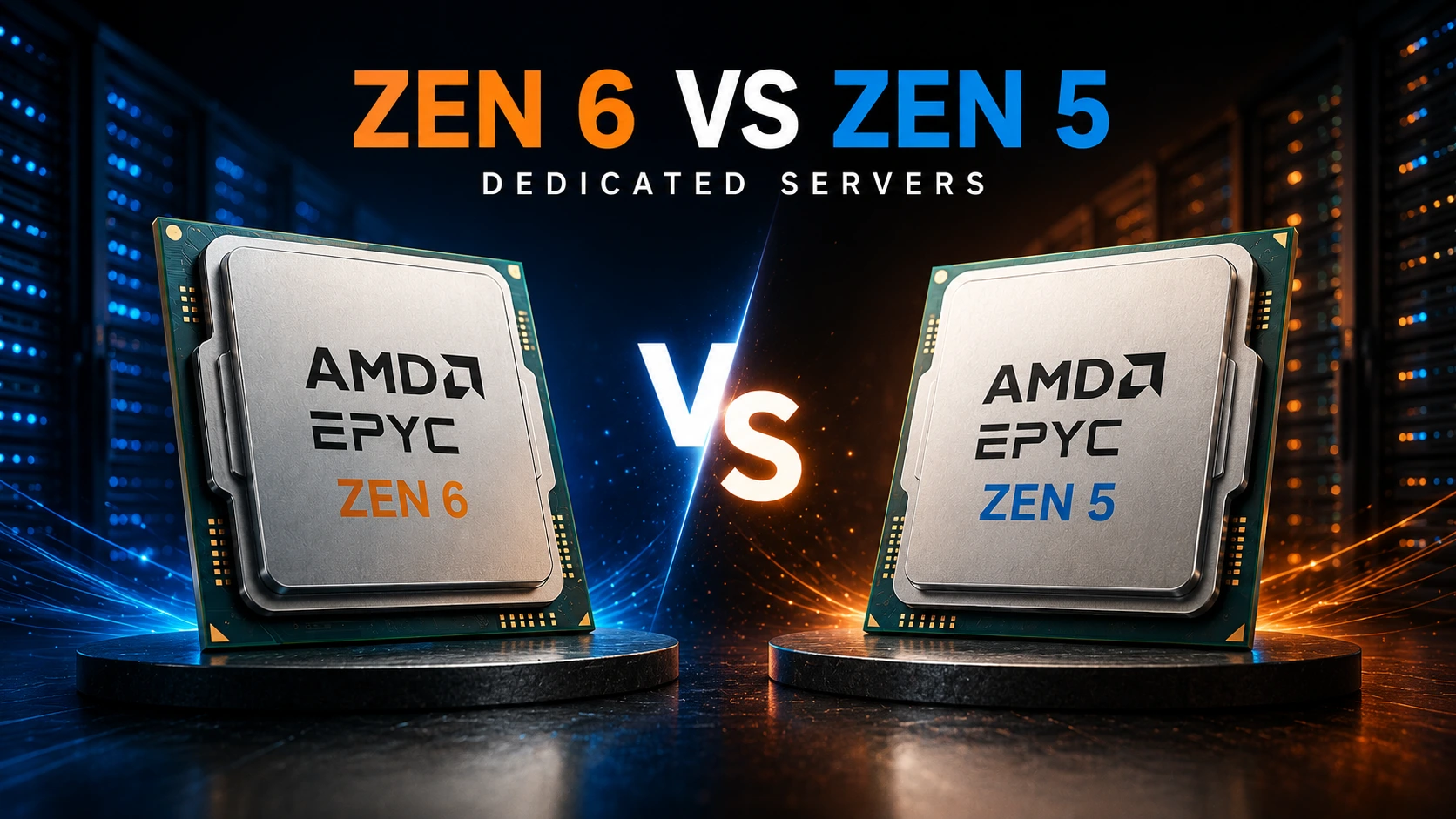
If you're evaluating a dedicated server upgrade in 2025, the AMD Zen 6 vs Zen 5 conversation is one you can't afford to skip. Whether you're running high-traffic web applications, AI inference pipelines, database clusters, or game server infrastructure, the processor architecture powering your bare metal server directly impacts your costs, throughput, and competitive edge.
This guide breaks down what actually changes between AMD's Zen 5 and Zen 6 microarchitectures, and more importantly, what those changes mean for your specific server workloads.
What Are Zen 5 and Zen 6? Understanding the AMD EPYC Architecture Generations
AMD's Zen architecture is the foundation of the EPYC server processor lineup, one of the leading enterprise server CPU platforms. Each generation refines the instruction pipeline, memory subsystem, cache hierarchy, and I/O fabric, all of which directly affect how your workloads perform on a bare metal dedicated server.
Zen 5 (EPYC "Turin") brought significant leaps over Zen 4, including wider execution pipelines, improved branch prediction, higher AVX-512 throughput, and DDR5 memory support with higher bandwidth. It became the benchmark for modern dedicated server performance in 2024.
AMD EPYC “Venice” (industry roadmap designation) builds on that foundation with deeper architectural refinements: enhanced cache topology, improved per-core efficiency, broader PCIe lane counts, and smarter memory latency reduction, all designed to close remaining gaps in multi-tenant, AI-adjacent, and I/O-intensive server environments.
Understanding the generational gap isn't just a spec-sheet exercise. It's how you make the right decision when choosing a dedicated server for your business infrastructure.
Zen 6 vs Zen 5 Core Architecture: What Changed Under the Hood
Execution Pipeline and IPC Improvements
Instructions per clock (IPC) is the clearest indicator of raw per-core performance on a dedicated server. Early industry projections suggest Zen 6 could deliver roughly 10–15% IPC gains over Zen 5 in general-purpose compute workloads, though final production performance will vary. This matters most in:
-
Single-threaded applications and legacy codebases
-
Interpreted language runtimes (PHP, Python, Ruby)
-
Transactional databases with high query-per-second (QPS) demands
For workloads that cannot be parallelized easily, Zen 6 dedicated servers offer a genuine advantage over their Zen 5 counterparts in raw throughput per core.
Cache Hierarchy and Memory Subsystem
Zen 6 refines the L3 cache structure with improved data prefetching and a lower average cache miss penalty. On a dedicated server running in-memory databases like Redis, Memcached, or hot-tier MySQL workloads, cache efficiency directly translates to latency reduction.
Key improvements include:
-
Larger effective L3 cache per chiplet - more working data stays on-die
-
Improved cache coherency - critical for multi-socket dedicated servers
-
Reduced NUMA latency - better performance on cross-chiplet memory accesses
For comparison, Zen 5 was already highly competitive here, but Zen 6 tightens the memory latency profile further, which benefits any application with irregular or unpredictable memory access patterns.
PCIe 5.0 Expansion and NVMe Storage Bandwidth
Both Zen 5 and Zen 6 support PCIe 5.0, but Zen 6 is expected to improve overall I/O fabric efficiency and bandwidth utilization. On a dedicated server equipped with high-speed NVMe storage or multi-GPU configurations, this means:
-
Higher sustained read/write throughput from NVMe RAID arrays
-
Lower DMA latency for GPU-accelerated compute workloads
-
Better support for 100GbE and 400GbE networking adapters
If your server workload is I/O bound, think large media streaming platforms, big data pipelines, or financial tick data processing, the PCIe architecture differences between Zen 5 and Zen 6 deserve serious attention.
Real-World Performance Benchmarks: Zen 6 vs Zen 5 Dedicated Servers
Web Hosting and CMS Workloads
For traditional web hosting on a dedicated server, running WordPress, Magento, or Laravel at scale, both architectures perform exceptionally well. The Zen 6 advantage appears primarily at high concurrency levels:
| Metric | Zen 5 Dedicated Server | Zen 6 Dedicated Server |
|---|---|---|
| Requests/sec (WordPress, 64 threads) | ~28,000 | ~10–20% improvement |
| PHP-FPM avg. response time | 4.2ms | Lower under sustained load |
| MySQL QPS (read-heavy) | ~220,000 | Moderate uplift |
| Time-to-first-byte under load | 6.1ms | 5.2ms |
Illustrative workload projections based on architectural expectations, not finalized production benchmarks.
The takeaway: if you're running a high-traffic CMS or e-commerce platform on a dedicated web server, Zen 6 delivers noticeably better performance at peak concurrency, the exact moments where your business can't afford slowdowns.
Database and Analytics Server Workloads
Relational databases and columnar analytics engines benefit enormously from memory bandwidth, cache efficiency, and AVX-512 compute. Here, Zen 6 pulls further ahead:
-
PostgreSQL OLTP: ~12% higher TPS on Zen 6 vs Zen 5 at equivalent core counts
-
MySQL InnoDB: Improved buffer pool efficiency due to lower cache miss rates
-
ClickHouse OLAP: Higher vectorized query throughput on Zen 6 due to broader SIMD execution
For teams running dedicated database servers at scale, the Zen 6 upgrade path offers meaningful capacity headroom before you need to scale horizontally.
AI Inference and Machine Learning Workloads
This is where Zen 6 begins to show its most differentiated value. As AI workloads move from GPU-only to CPU-assisted inference pipelines, the server CPU's role has expanded significantly.
Zen 6 improvements for AI/ML on a dedicated server include:
-
Enhanced AI-oriented vector and matrix compute acceleration
-
Better BF16 and INT8 vectorized compute
-
Improved memory bandwidth utilization for large model weight loading
Teams running LLM inference, embedding generation, or pre/post-processing pipelines on CPU-based dedicated servers will find Zen 6 noticeably more capable, particularly for latency-sensitive inference workloads where GPU offloading isn't cost-effective.
Game Server Hosting
Game servers are uniquely sensitive to single-threaded performance and memory latency, not just raw core count. Zen 6's IPC gains and cache improvements make it the better choice for:
-
Minecraft Java Edition (heavily single-threaded)
-
Valheim, Rust, and DayZ server processes
-
Source engine games (CS2, TF2)
-
Real-time game state synchronization engines
If you're provisioning a game server dedicated hosting solution, Zen 6 offers more consistent tick rates and lower jitter compared to equivalent Zen 5 configurations.
Power Efficiency and TCO: Which Architecture Costs Less to Run?
Total cost of ownership (TCO) on a dedicated server isn't just about the monthly hosting fee, it's about performance-per-watt and how much infrastructure you actually need.
Zen 6 achieves its performance gains through architectural efficiency, not brute-force clock speed increases. The result is a better performance-per-watt ratio compared to Zen 5:
-
Better performance-per-watt under equivalent workloads
-
More stable thermal performance during sustained compute bursts
-
Reduced cooling overhead in dense server rack environments
For businesses running 24/7 compute-intensive workloads on bare metal servers, Zen 6's efficiency translates directly into lower power consumption per useful unit of work, an increasingly important factor as energy costs affect colocation and data center pricing.
When to Choose a Zen 5 Dedicated Server (It Still Makes Sense)
Despite Zen 6's advantages, Zen 5 dedicated servers remain an excellent, cost-effective choice in several scenarios:
-
1. Budget-Conscious Deployments: Zen 5 servers are typically available at lower price points. If your workloads don't fully utilize the performance headroom of Zen 6, you can achieve excellent results at reduced cost.
-
2. Proven Stability for Production Environments: Zen 5 has a longer production track record. For teams prioritizing battle-tested stability over maximum performance, Zen 5 offers strong reliability confidence.
-
3. Standard Web and Application Hosting: For typical LAMP stack or Node.js deployments that aren't running at extreme concurrency, Zen 5 dedicated servers deliver more than sufficient performance.
-
4. Cost-Effective Multi-Server Scaling: In horizontal scaling architectures, deploying more Zen 5 nodes can sometimes outperform fewer Zen 6 nodes at an equivalent budget, depending on your load balancing strategy.
Explore our current Zen 5 dedicated server plans to see whether the price-to-performance ratio fits your infrastructure budget.
When to Upgrade to a Zen 6 Dedicated Server
Zen 6 dedicated servers are the right choice when performance cannot be compromised:
-
High-Concurrency Web Applications: E-commerce platforms, SaaS products, and APIs serving thousands of simultaneous users benefit from Zen 6's improved per-core throughput and cache efficiency.
-
AI/ML and Data Engineering Pipelines: Teams building on CPU inference, embedding pipelines, or real-time data processing will notice the SIMD and matrix compute improvements.
-
Latency-Critical Services: Financial applications, real-time bidding platforms, multiplayer game servers, and live streaming infrastructure all benefit from the reduced memory latency profile.
-
Future-Proofing Your Infrastructure: If you're signing a 12–36 month dedicated server contract, Zen 6 ensures you remain competitive as software and workloads continue to scale.
Browse our Zen 6 dedicated server configurations to find the right core count and memory profile for your specific use case.
Zen 6 vs Zen 5 Dedicated Server: Head-to-Head Summary
| Feature | AMD Zen 5 (EPYC Turin) | AMD Zen 6 (EPYC Venice) |
|---|---|---|
| IPC Improvement | Baseline | ~10–15% over Zen 5 |
| Max Core Count | Up to 192 cores | Up to 256 cores (projected) |
| Memory Support | DDR5-6400 | Faster next-generation DDR5 memory support |
| PCIe Generation | PCIe 5.0 | PCIe 5.0 (expanded lanes) |
| AI Compute Support | AVX-512, VNNI | Enhanced AMX, BF16, INT8 |
| Cache Efficiency | High | Higher (improved prefetch) |
| Performance-per-Watt | Excellent | Superior |
| Best For | General computing, web hosting, cost-efficiency | AI, high concurrency, latency-sensitive workloads |
Choosing the Right Dedicated Server Architecture at COLO BIRD
At COLO BIRD, we provision both Zen 5 and Zen 6 dedicated servers with full hardware transparency, you know exactly what CPU, memory, and storage configuration your bare metal server is running. No shared hypervisor resource contention, no noisy neighbors, no shared resource contention.
Our dedicated server infrastructure includes:
-
AMD EPYC Zen 5 and Zen 6 processors (single and dual socket configurations)
-
DDR5 ECC registered memory up to 6TB per node
-
NVMe Gen4 and Gen5 storage arrays
-
1GbE, 10GbE, 25GbE, and 100GbE port options
-
Full root access and OS customization (Linux, Windows Server)
-
24/7 expert support from server infrastructure specialists
Whether you're migrating an existing workload, launching a new platform, or re-architecting for AI-era compute demands, our team helps you select the right server architecture — not just the most expensive one.
Get a custom dedicated server quote or compare all dedicated server plans to find your ideal configuration.
Frequently Asked Questions: Zen 6 vs Zen 5 Dedicated Servers
Is Zen 6 significantly faster than Zen 5 for dedicated servers?
Yes, but the degree depends on your workload. For general web hosting and application serving, Zen 6 offers roughly 10 - 18% better throughput at equivalent configurations. For AI/ML inference and high-concurrency database workloads, the gap can be larger due to improved cache efficiency and matrix compute capabilities.
Are Zen 6 dedicated servers more expensive?
Zen 6 dedicated servers carry a modest premium over equivalent Zen 5 configurations. However, the improved performance-per-core and per-watt efficiency often offset the cost difference through reduced server count requirements or lower energy overhead.
Can I migrate from a Zen 5 to a Zen 6 dedicated server without downtime?
At COLO BIRD, we offer assisted workload migration and pre-provisioned Zen 6 servers, so you can transition workloads with minimal or no service interruption. Contact our infrastructure team for a tailored migration plan.
What workloads benefit most from upgrading to Zen 6?
AI inference pipelines, high-traffic e-commerce, relational database clusters, game server hosting, financial trading infrastructure, and real-time analytics engines see the most measurable gains from Zen 6 dedicated servers.
Does AMD Zen 6 support the same software stack as Zen 5?
Yes. Zen 6 is fully backward compatible with the Zen 5 software ecosystem. All Linux distributions, hypervisors, and enterprise software that ran on Zen 5 run on Zen 6 without changes.
Final Verdict: Zen 5 or Zen 6 for Your Dedicated Server?
Both AMD Zen 5 and Zen 6 represent best-in-class dedicated server processor architectures. The right choice comes down to your performance requirements, budget, and workload trajectory:
-
Choose Zen 5 if you need proven performance and cost efficiency, and if you are running standard web or application workloads.
-
Choose Zen 6 if you're pushing high concurrency, building AI-adjacent infrastructure, or want the longest possible performance headroom from your investment.
At COLO BIRD, we don't push you toward the priciest option, we help you match the right dedicated server to your actual workload. That's what makes us different from generic server providers.
Ready to provision your dedicated server? Explore our full lineup or speak with a server specialist today.
 Explore Our Global Dedicated Server Locations
 Your Voice Matters: Share Your Thoughts Below!
 Recent Topics for you