Quick Summary: B200 vs. H100 Compute Economics in 2026
-
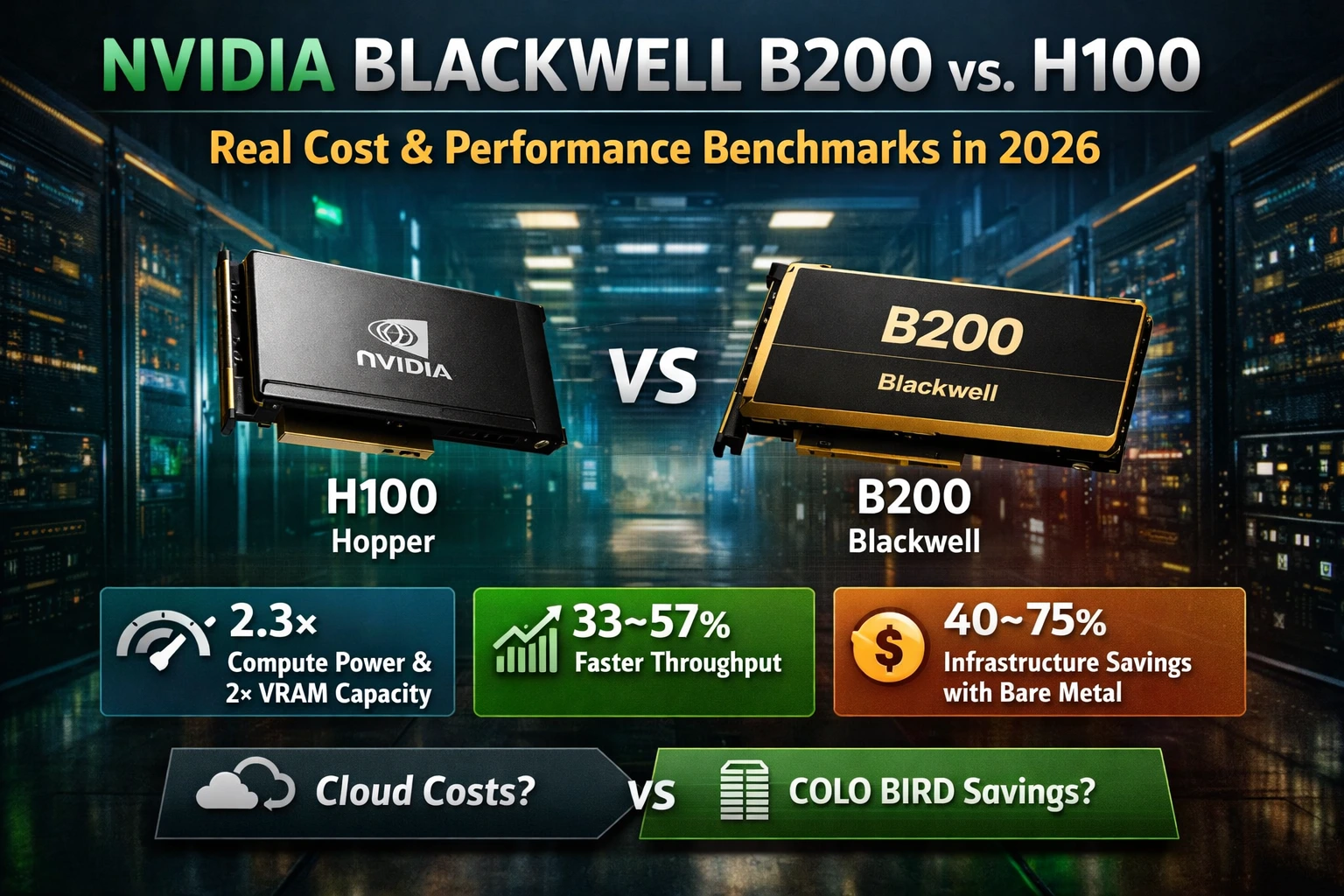
The Architecture Shift: NVIDIA’s Blackwell B200 accelerator delivers approximately 2.2–2.3× the tensor compute performance and double the VRAM capacity of the previous-generation Hopper H100.
-
Throughput Benchmarks: For massive-scale computer vision and LLM parameter updates, the B200 yields a 33% to 57% throughput advantage, driven by its expansive memory bandwidth (~8.0 TB/s).
-
The ROI Verdict: While B200 cloud instances demand $3.95–$8.00/hr, migrating continuous workloads to COLO BIRD bare-metal servers reduces infrastructure CapEx by 40% to 75%.
NVIDIA Blackwell B200 vs. H100 Dedicated Servers: Real Cost & Performance Benchmarks (2026)
NVIDIA’s Blackwell architecture (B100, B200, GB200) achieved volume distribution in late 2025. By early 2026, the NVIDIA B200 has firmly cemented its position as the foundational GPU for intensive LLM training pipelines, massive-scale fine-tuning, and high-throughput inference APIs.
However, as neural network parameters scale, AI research labs face a critical dilemma: Exactly how much computational superiority does the B200 hold over the H100? And at what utilization threshold does it become financially prudent to deploy bare-metal physical infrastructure rather than leasing hyperscale cloud instances?
In this technical breakdown, we benchmark the NVIDIA Blackwell B200 directly against the H100 utilizing early 2026 empirical data, analyzing token generation throughput, power efficiency, and the precise financial break-even point.
Hardware Architecture: B200 vs. H100 (March 2026)
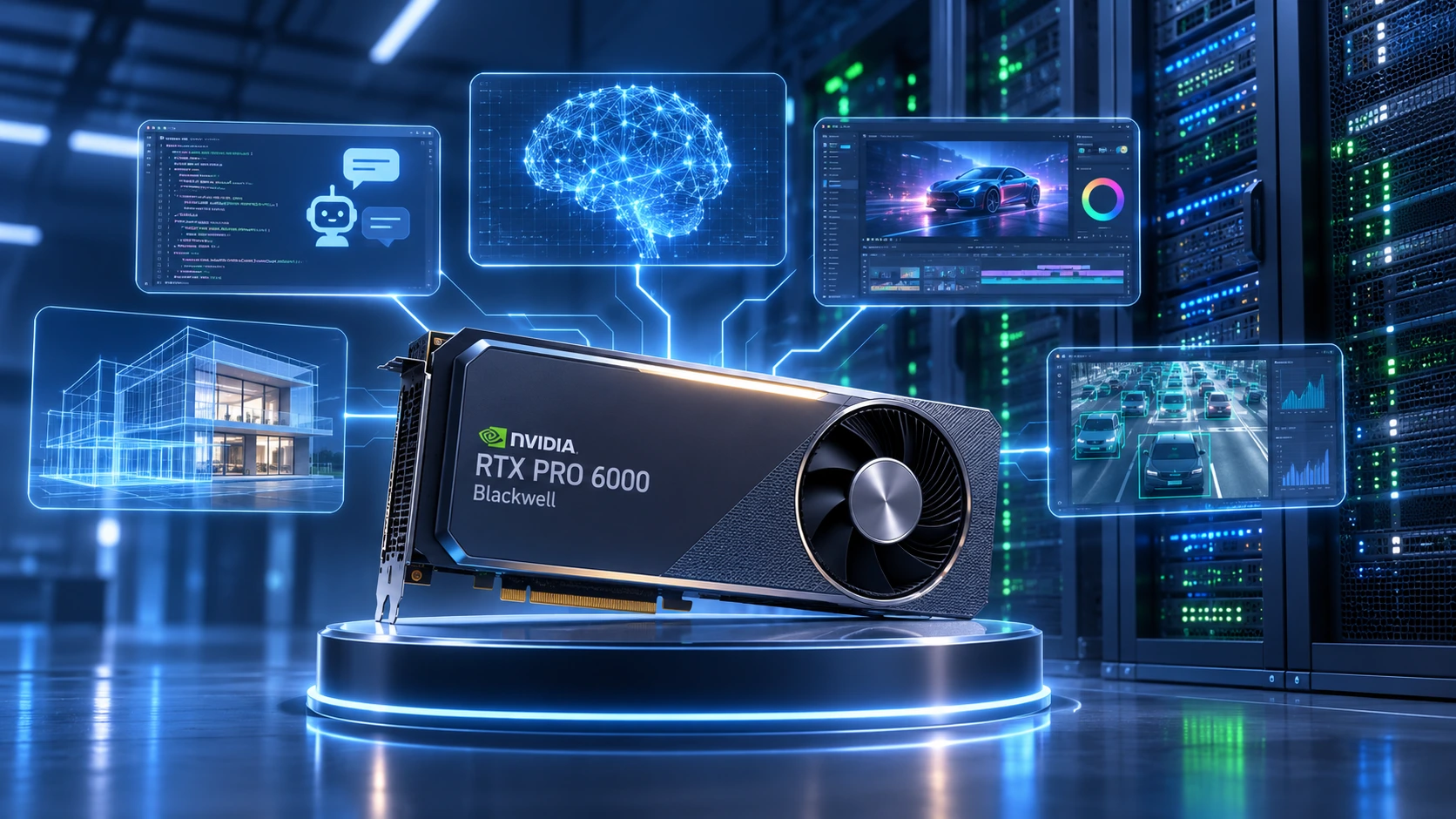
The generational leap from Hopper to Blackwell is fundamentally defined by VRAM expansion and native FP8/FP4 calculation efficiency. Below is the technical breakdown comparing these two enterprise accelerator cards:
| Performance Metric | NVIDIA H100 (Hopper) | NVIDIA B200 (Blackwell) | The Architectural Advantage |
|---|---|---|---|
| Microarchitecture | Hopper | Blackwell B200 | Next-gen logic routing |
| VRAM Capacity | 80 GB HBM3 | 192 GB HBM3e | B200 (Enables massive batch sizes) |
| Memory Bandwidth | ~3.35 TB/s | ~8.0 TB/s | B200 (~2.4× faster transfer) |
| FP16/BF16 Tensor | ~1,979 TFLOPS | ~4,500–5,000 TFLOPS | B200 (~2.2–2.3× raw speed) |
| Cloud On-Demand | $2.80–$8.50 / hr | $3.95–$8.00 / hr | H100 (Cheaper for burst) |
Real-World Deep Learning Benchmarks in 2026
1. Computer Vision Pretraining: Based on 8× GPU topology runs, Blackwell’s expanded VRAM eradicates memory bottlenecks. At max batch sizes (4096), the B200 provides a 57% overall throughput acceleration compared to H100.
2. LLM Inference Pipelines: Early 2026 inference on quantized models shows the B200 is 10–15% faster for Gemma 27B. For larger models like DeepSeek 671B, performance is currently on par as software stacks (vLLM) continue to optimize for Blackwell instructions.
Power Consumption & Efficiency
| Power Metric | H100 (8× GPU Topology) | B200 (8× GPU Topology) | Infrastructure Notes |
|---|---|---|---|
| Peak GPU Draw | ~600 W per GPU | ~700–900 W per GPU | B200 has higher efficiency per TFLOP |
| Full Node Draw | ~5.5–6.5 kW | ~6.5–8.0 kW | Includes CPUs, RAM & NVLink |
Infrastructure Cost Analysis: Cloud vs. Bare Metal
For organizations operating sustained AI pipelines, cloud virtualization transforms into a massive operational liability. Below is the financial breakdown of operating a 4-node GPU cluster in March 2026:
| Deployment Architecture | GPU Count | Monthly Compute Cost | 30-Day OpEx | 90-Day OpEx | Savings vs. Cloud |
|---|---|---|---|---|---|
| AWS p5 / GCP A3 | 4× | $15,000 – $28,000 | $15,000 – $28,000 | $45,000 – $84,000 | — |
| CoreWeave / Lambda | 4× | $9,000 – $14,000 | $9,000 – $14,000 | $27,000 – $42,000 | — |
| COLO BIRD B200 Bare Metal | 4× | $4,800 – $7,200 | $4,800 – $7,200 | $14,400 – $21,600 | 45–70% |
| COLO BIRD B200 Bare Metal | 8× | $9,200 – $13,500 | $9,200 – $13,500 | $27,600 – $40,500 | 50–75% |
⚖️ The Compute Break-Even Calculation: If your compute exceeds 15 days per month, single-tenant physical infrastructure pulls ahead dramatically. For continuous 24/7 operations, fixed-rate bare metal reduces CapEx by 50–80% over a 90-day lifecycle.
Procurement Decision Matrix: When to Provision Physical Hardware
-
Does your team sustain training workloads for more than 15–20 days per month? → Provision COLO BIRD Bare Metal
-
Do you require absolute kernel-level root access for custom CUDA optimizations? → Provision COLO BIRD Bare Metal
-
Is proprietary data privacy and single-tenant isolation mandatory? → Provision COLO BIRD Bare Metal
-
Do you need to orchestrate 1,000+ GPUs instantly for a 48-hour experiment? → Cloud Elasticity is better
Architecting Blackwell Infrastructure with COLO BIRD
At COLO BIRD, we engineer enterprise-grade AI infrastructure designed to eliminate virtualization overhead and the "cloud tax." We offer true bare-metal environments with unmitigated NVLink bandwidth and global data residency across 250+ data centers.
Evaluating a specific foundational model size or training duration? Contact our engineering team for a data-backed compute estimate comparing our physical servers directly against your current cloud expenditure.
 Explore
Our Global Dedicated
Server Locations
Explore
Our Global Dedicated
Server Locations Your Voice Matters: Share Your Thoughts Below!
 Recent Topics for you